

There are various ways that different Christian groups connect and conflict. One example is how we treat the miraculous: accounts of healings, demons being cast out, and people being raised from the dead. I’ll caricature slightly here, with the alignments of three groups. Charismatics are Christians (often evangelical) who expect miracles today as a normal part of the Christian life. Liberal Christians in the 20th century were generally marked by scepticism about miracle accounts in the Bible (e.g. the virgin birth of Jesus). [21st Century liberal Christianity seems happier affirming the miraculous, and sceptical about the Bible’s moral teaching being clear and lasting.] Conservative Evangelical Christians believe that God can and has done miraculous acts, but are sceptical that they are common or expected in church today.
So here is how I think they line up:
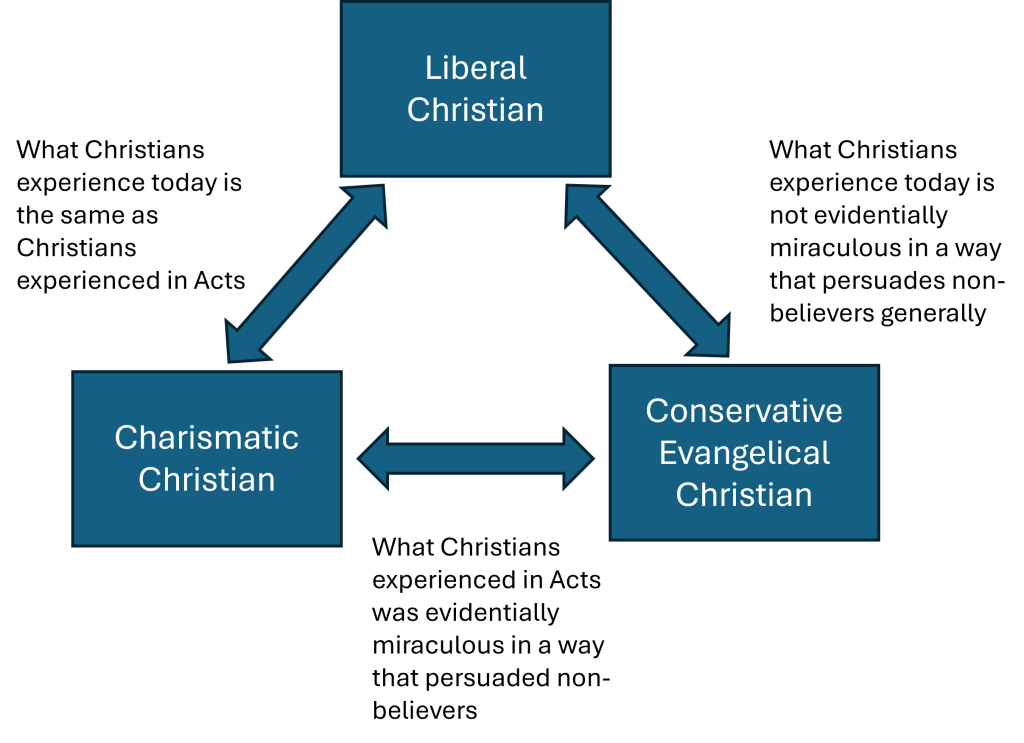
The areas of agreement and disagreement relate to the miraculous events in the book of Acts, and the experience of Christians in church today.
Charismatic and Conservative Evangelical Christians agree that God did amazing miracles through Jesus and then the Apostles. The early church saw miracles of such quality and quantity that it became a major factor in people becoming Christians. Non-Christians saw blind people given sight, or crippled beggars jumping around, and they knew something supernatural had happened.
Charismatic and Liberal Christians agree in seeing the church experience today and the church experience in Acts (with regard to the miraculous) as similar. For Charismatics, that means they expect to see (and some testify to seeing) remarkable miracles today. Not every church meeting. But often enough to be a compelling part of the church’s witness. People healed of cancer, of disabilities, even the dead raised to life. For Liberals, the minor miracles of today, the divine coincidences and “it just so happened” that sometimes people get better after being prayed for, the vague and sometimes right sense that God has spoken or guided- this is all the early church of Acts experienced too. They don’t agree with the Charismatic description of modern church miracles- but they think the language of miracle applied to it is the same sort of language inflation as happened in Acts.
Conservative Evangelical and Liberal Christians agree that we don’t see evidentially compelling miracles in church normally today. We may believe God is at work through history, by his Spirit in people’s lives, and even in subtle supernatural ways. But these “healings” and “guidances” and “coincidences” are not evidentially compelling to the onlooking unbeliever. The believer may rightly take them as signs of God’s kindness and power towards them. Bu the unbeliever sees confirmation bias, uncertainty, and unknown natural causes as at least as likely as a supernatural cause. (Conservative Evangelical Christians generally believe that God can do evidential miracles today, and even may be doing it in certain parts of the world more frequently. But they don’t see it happening much in their own church or culture.)
Do you think that is right? Does that help you make sense of the differences between these forms of Christianity? Where would you place yourself in that diagram?


Clever diagram, I like what you’ve done there, and the criteria of “evidentially miraculous that persuade non-believers”. I’d picked up that liberals no longer believed the Bible’s moral teaching to be clear or lasting, I hadn’t appreciated this was a swaperoo, where the old liberals believed the morals but not the miracles, the new liberals believe the miracles but not the morals. I have reservations about the epistemic integrity of any system capable of such drastic swings in conclusions without any apparent swing in input data. (I guess there is a swing in input data – the culture around us has swung, and this turns out to be a (the?) key input to the liberal deductive process.)
LikeLiked by 1 person
Yes, liberal Christianity is particularly sensitive to the culture around it. Evangelical Christianity (and tradition/institution oriented churches like Roman Catholicism) are also affected by the culture around but putting more weight on Scripture/ tradition limits the change.
LikeLike