

(This is an attempt to model some dynamics I have seen in relationships. It’s entirely possible psychologists or sociologists have an established version of this- if you know of one I’d be interested to learn more.)
Every relationship involves two imperfect people. Every person is a sinner. Every person is also broken in various ways. And even in our created goodness our ways of thinking and feeling and working vary, in ways that can be baffling or frustrating to others.
So normal good relationships involve lots of “overlooking” small annoyances, bearing with things that we don’t fully understand and assuming the best of people. The famous passage on love in 1 Corinthians 13 speaks of an attitude that helps imperfect people to keep enduring and enjoying their relationship: 4 Love is patient, love is kind. It does not envy, it does not boast, it is not proud. 5 It does not dishonour others, it is not self-seeking, it is not easily angered, it keeps no record of wrongs. 6 Love does not delight in evil but rejoices with the truth. 7 It always protects, always trusts, always hopes, always perseveres.
My observation is that in normal relationships, this overlooking and bearing with and assuming the best comes from tanks of love and trust that are kept topped up. A wife may annoy a husband in various ways, may have spoken harshly in a moment of anger, may not have remembered a particular appointment. These cause the love and trust tank levels to decrease. But where the overall relationship tanks of love and trust have been kept topped up, the husband can respond with grace and forbearance. Where the wife is overall reliable in tasks, truthful in communication, where there have been little acts of kindness and words of love and gifts, then the love and trust tanks are full enough to handle the little frustrations that emerge. (And you could retell the illustration for how a husband annoys and loves his wife!)
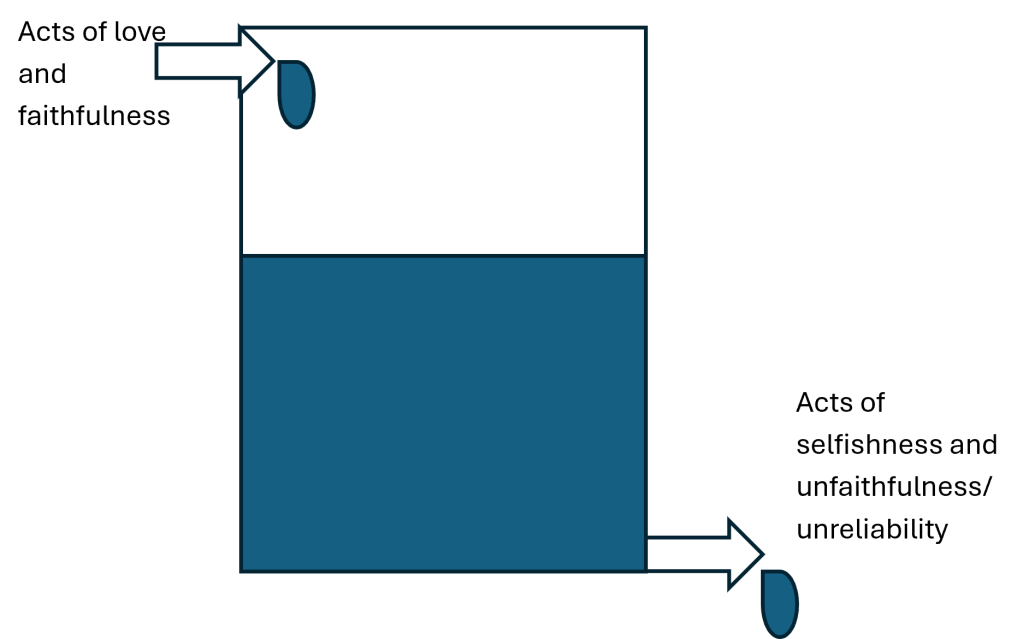
A relationship with the love and trust tanks kept topped up by regular reliability, truthfulness, kindness and generosity can weather the occasional frustrations and even sinful acts. If your default attitude is that your partner loves you and is a trustworthy person, then mistakes, frustrations, and sins are interpreted as small problems to be dealt with or endured, but don’t threaten the fundamental relationship. If the love and trust tank is kept above the threshold of love and trust, good deeds are given full credit as the true person, and unloving or unreliable deeds are treated with grace, as less threatening to the relationship.
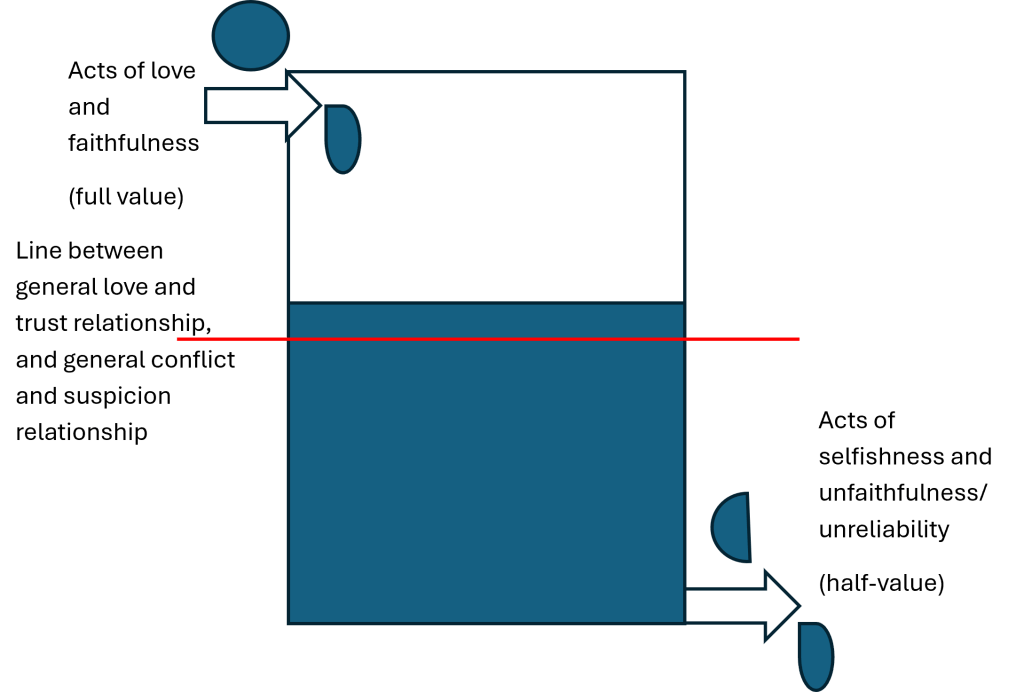
But all that changes if the love and trust tanks start getting empty. If there are not acts of love and kindness topping up the love tanks, if there is not faithful reliability and general truthfulness being shown, then every mistake or frustration or sin sends the love and trust tanks to empty with no refilling to counter it. And if the frustrating acts and sins are frequent and not repented of, that also drives the love and trust tanks to empty. In doing so, it crosses a love and trust line. Above that line, the relationship is a love and trust relationship. Below that line, the relationship is a conflict and suspicion relationship, in which the assumption is that the other person is unreliable and not acting out of love for me.
Once the love and trust tanks have crossed that love and trust threshold, the same mistakes, frustrations and sins get viewed in a different light. They are now evidence of the negative view a person has of the other person, and reinforcing the negative pattern. And once in this state, the acts of love and kindness, the moments of trustworthiness and truth, get viewed suspiciously as trying to get something, as manipulation, asaberrations not revelations of character.
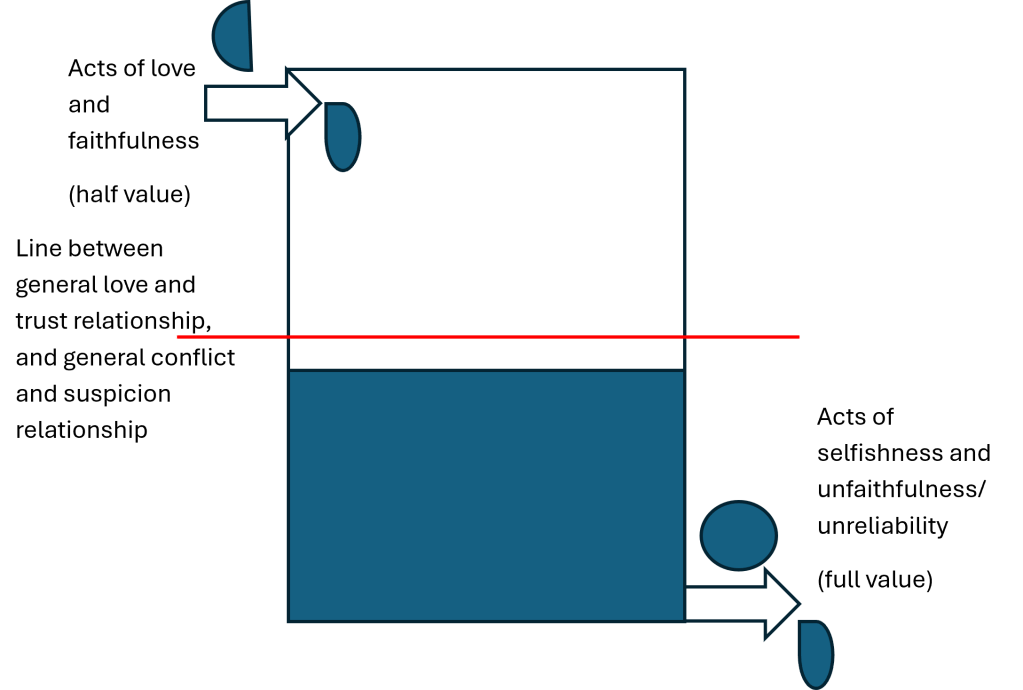
So while the acts of love and trust that build relationship and the acts of selfishness and unreliability that damage relationships can look like they have a simple topping up or draining effect on the love and trust tank level, there is actually a binary dynamic. Switching from a love and trust positive relationship to an uncaring and distrustful relationship radically changes how the same set of actions are perceived, and their ongoing impact on the love and trust tank. What this model highlights is that relationships can break not only because of a big betrayal (like adultery) but because of lots of small failures building up over time.
In future posts, I hope to explore some of the implications of this for marriage and for church relationships.


